
Agent-Ready SaaS Boilerplates
Agent-ready boilerplates ship the files an AI coding agent needs to work in your codebase without being told everything twice: an AGENTS.md or CLAUDE.md with real project rules, and usually Cursor rules, Claude skills, subagents or MCP servers on top. Every listing here was checked against public vendor documentation, and we record what we could verify rather than what is merely advertised. Anything we could not confirm is marked as not documented, never as missing.
Read the 10-point agent-ready checklist we score against → NextJS
  React
React  TypeScript
  Tailwind
  Drizzle



 Nuxt
Nuxt 

 Remix
Remix 



 Expo
Expo  Plasmo

 Prisma


 NodeJS
  Stripe



 Django
  HTMX
HTMX 

 Chakra
  Figma
Figma 


Best SaaS Boilerplates in 2026
BoilerplateHub curates 100+ vetted SaaS boilerplates so you can compare options side by side and pick the one that fits your stack. Whether you need the best Next.js SaaS boilerplate, a Laravel starter kit, a Django SaaS template, or a React Native mobile boilerplate, every listing includes verified pricing, tech stack details, and a full feature breakdown, so you know exactly what you're getting before you buy.
Most Popular SaaS Boilerplates
The most-used SaaS boilerplates are built on Next.js. Options like ShipFast, LaunchFast, and Shipped dominate because Next.js is the default choice for production React apps. For PHP teams, Laravel SaaS boilerplates like Larafast and SaaSykit offer the same batteries-included experience. Python developers lean on SaaS Pegasus, the most mature Django SaaS boilerplate available. And for mobile-first products, React Native and Expo SaaS starter kits let you share auth, billing, and API logic across iOS and Android from a single codebase.
What Separates Good SaaS Boilerplates from Great Ones
The best SaaS boilerplates go beyond wiring up auth and Stripe. Look for active maintenance: GitHub commits in the last 90 days signal a healthy project. Multi-tenancy support matters if you're building B2B. A built-in blog and landing page saves another week of work. Admin panels, dark mode, and onboarding flows ship products that feel polished from day one. Use the feature filters above to find SaaS boilerplates that match your exact checklist.
Free vs. Paid SaaS Boilerplates
Free SaaS boilerplates on GitHub are a solid starting point, but they often lack documentation, support, and regular updates as frameworks evolve. Paid SaaS boilerplates in the $49–$300 range come with setup guides, author support, and updates that track Next.js, Laravel, and other framework releases. For a production product, the license fee pays back in the first sprint. A developer's time costs far more per hour than a one-time boilerplate purchase.
Agent-Ready Boilerplates Compared
Every boilerplate below is listed in our catalog with verified pricing. We compare by stack fit, included integrations, and price, not by affiliate payout.
| Boilerplate | Price | Auth | Payments | Database | AI | ||
|---|---|---|---|---|---|---|---|
| TurboStarter | $299 - $499 | ✓ | ✓ | – | – | ✓ | Review → |
| SaaS Pegasus | $249 - $999 | ✓ | ✓ | – | – | ✓ | Review → |
| MakerKit | $299 - $599 | ✓ | ✓ | – | – | – | Review → |
| Agentic Boilerplate | $99 | ✓ | ✓ | ✓ | ✓ | ✓ | Review → |
| Saas UI | $49 - $799 | – | – | – | – | – | Review → |
| Gravity | $506 - $2995 | ✓ | ✓ | – | – | ✓ | Review → |
| Dirstarter | $159 - $199 | – | ✓ | – | – | ✓ | Review → |
| supastarter | $349 - $1499 | ✓ | ✓ | ✓ | ✓ | ✓ | Review → |
All 8 Agent-Ready Boilerplates
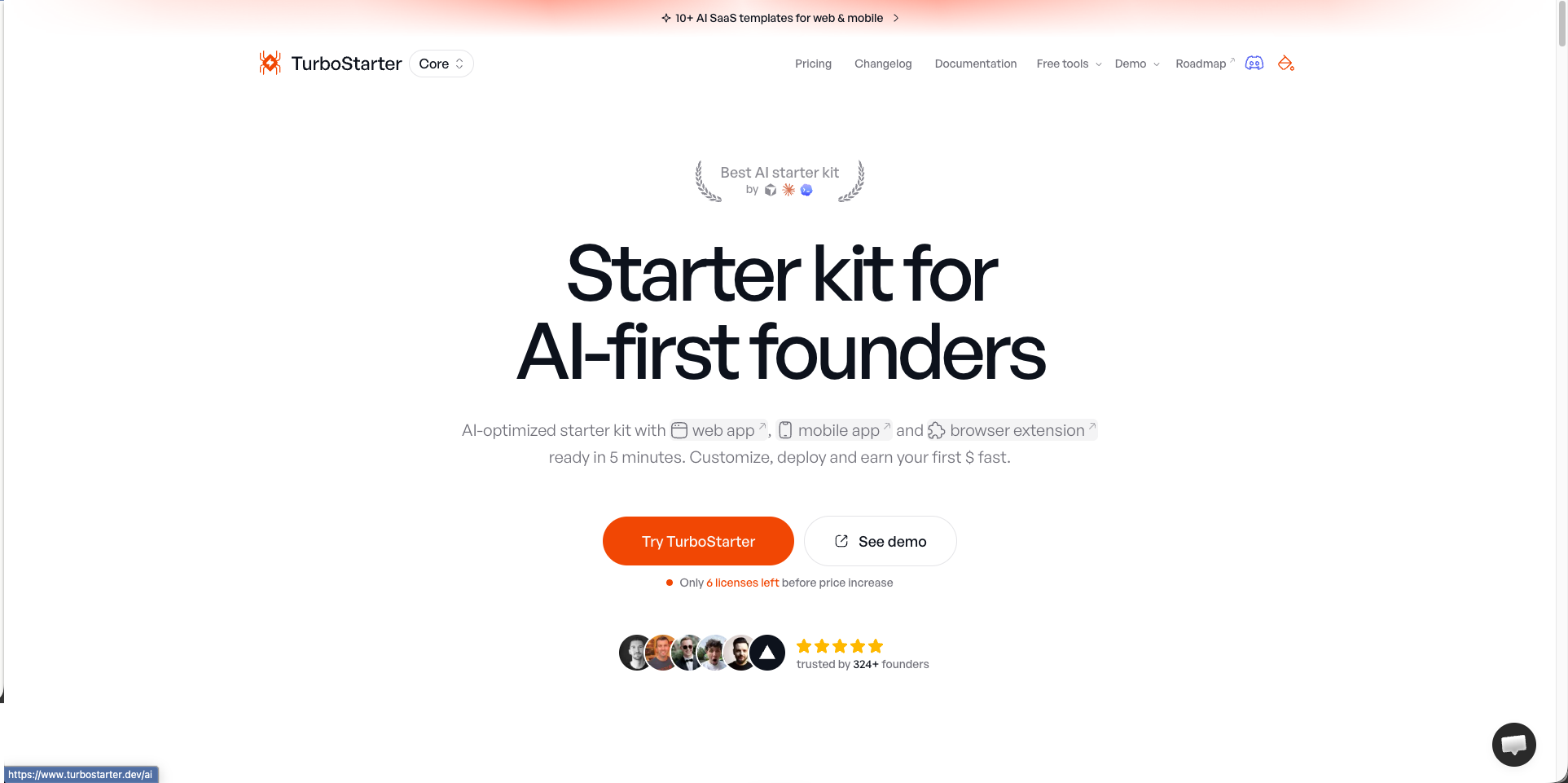
TurboStarter
Three targets from one codebase, web on NextJS, mobile on Expo and React Native, and a browser extension via Plasmo, all on Supabase with multi-tenancy, admin panel, AI and payments. Nothing else in the catalog spans that combination. The $299 to $499 range is roughly two to three times the $157 median, and the breadth is what you are paying for. Fair warning on scope: a monorepo covering three platforms carries real setup and maintenance overhead, so it only pays off if you genuinely ship to more than one.
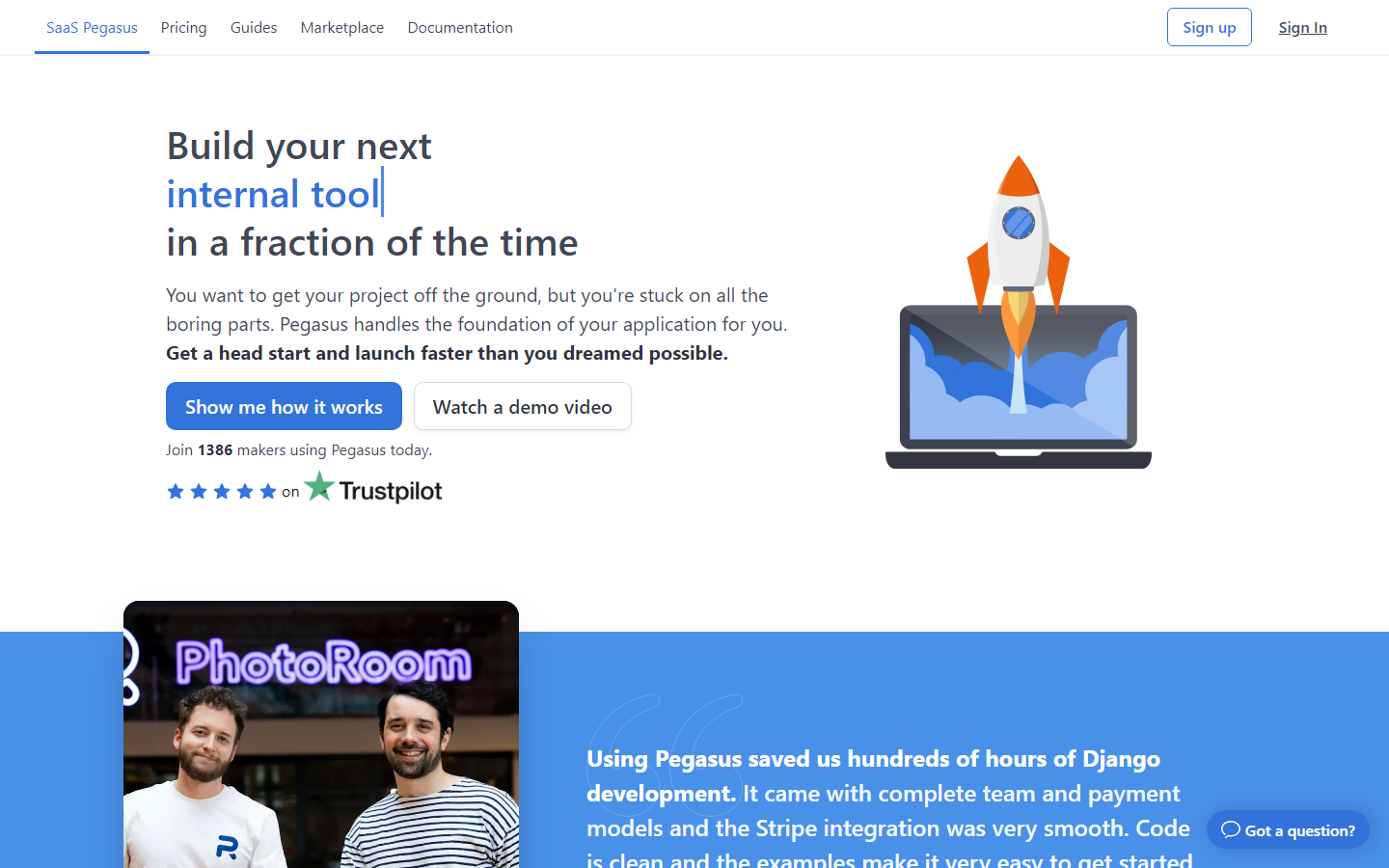
SaaS Pegasus
Django with Python underneath, offering a choice of React or HTMX on the front end and Tailwind, Bootstrap, or Bulma for styling. Teams, user accounts, Stripe billing, a CMS, and AI features come prebuilt, which makes it a serious option for developers who prefer a batteries included backend framework over a JavaScript runtime. Pricing of $249 to $999 is a clear premium over the $157 median, and the upper tiers are among the highest here. Python is the requirement to weigh: nothing carries over if your team is JavaScript only.
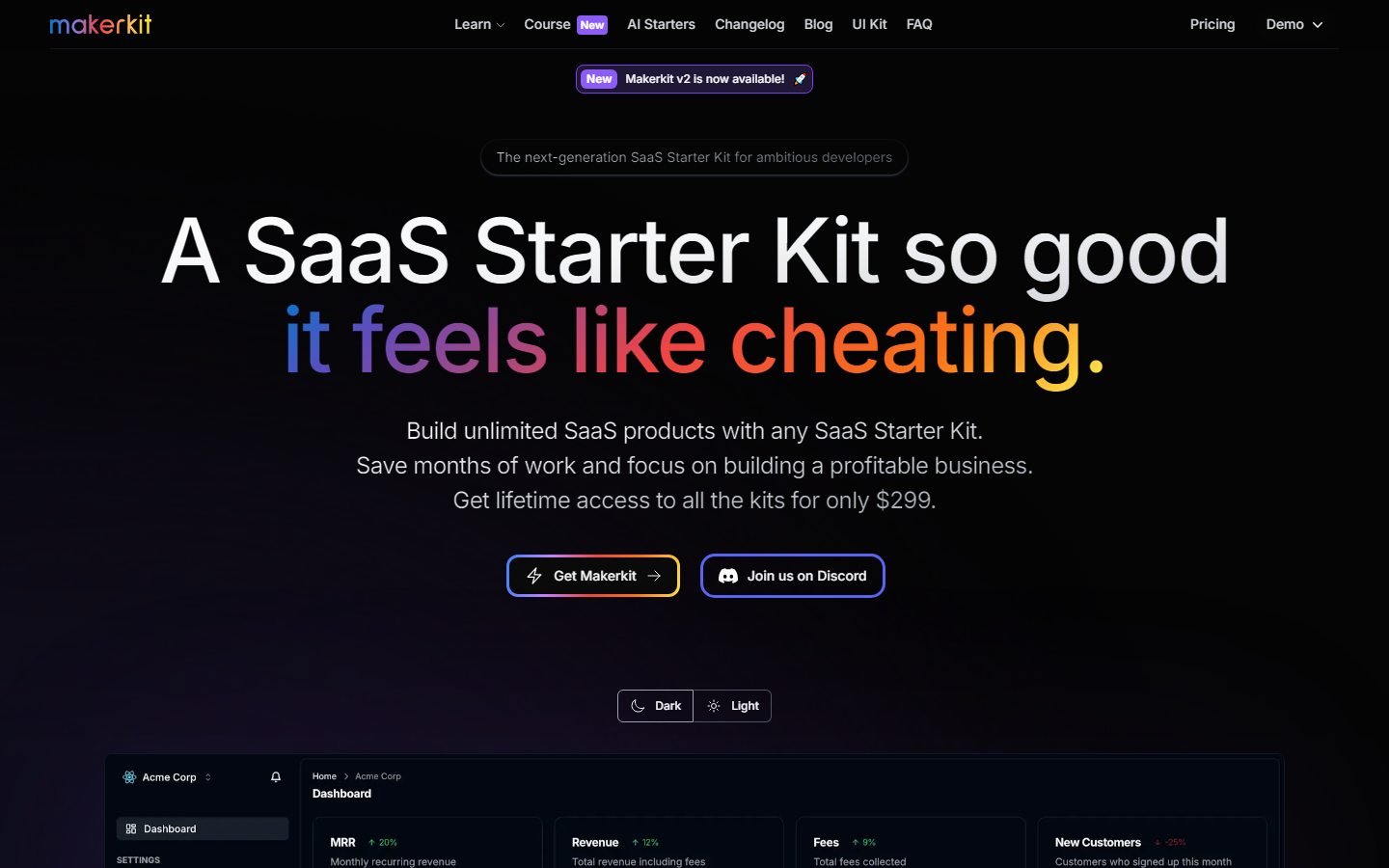
MakerKit
Multi-tenancy is the differentiator: a production-grade NextJS and Supabase foundation, also available for Remix, covering teams, roles, Stripe billing, admin panel, documentation and a plugin system. That B2B focus explains the $299 to $599 range, roughly two to four times the $157 median and among the pricier options here. Documentation and plugins suggest it expects long-lived projects rather than weekend launches. The tradeoff is cost and complexity: if you are shipping a single-tenant consumer tool, you pay a premium for tenancy machinery you will not use.

Agentic Boilerplate
A Next.js SaaS starter that ships only the services you pick, plus the AGENTS.md, rules, skills and subagents your coding agent needs to work in it.
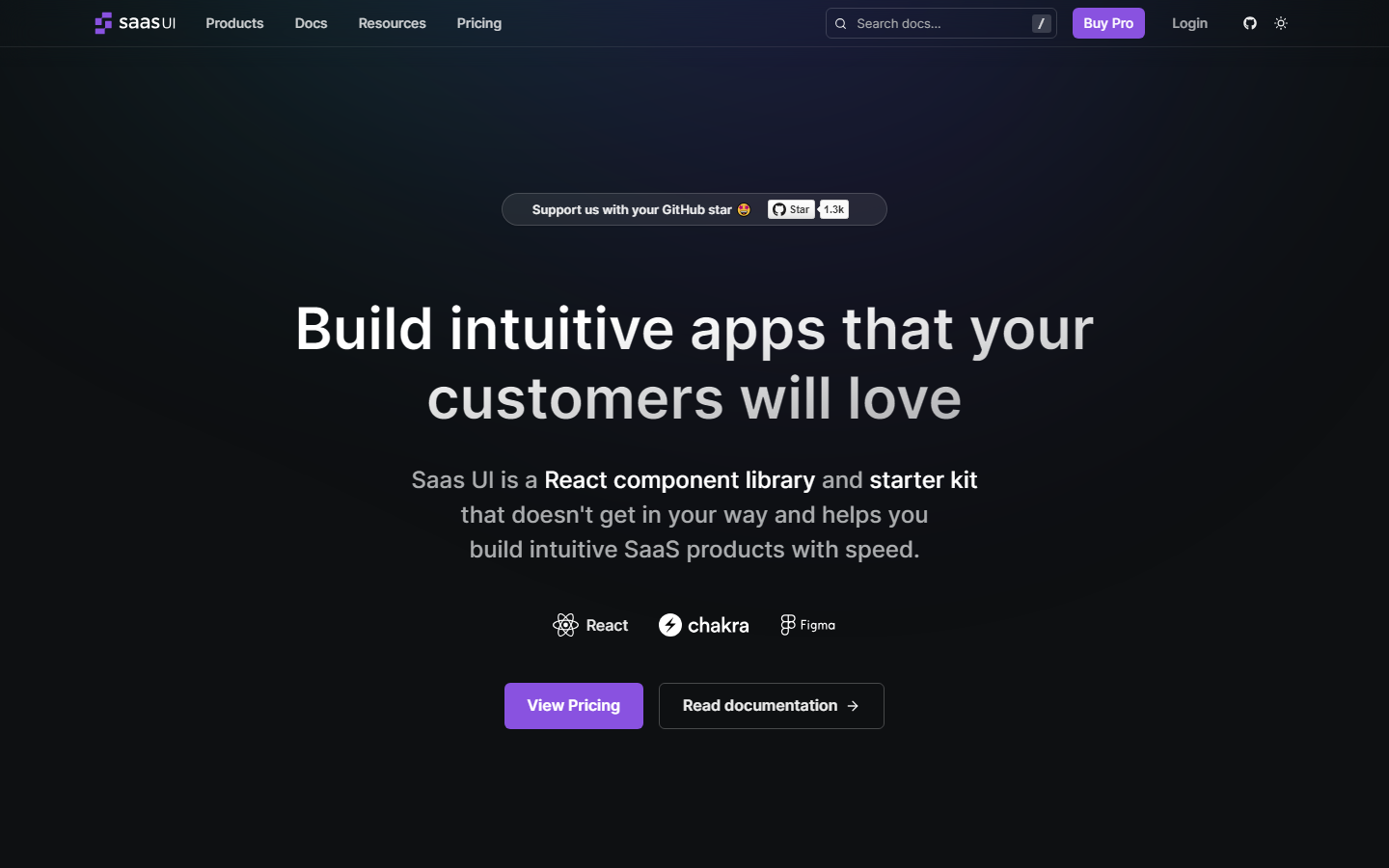
Saas UI
Saas UI is a component toolkit rather than a full application: 40 plus React components built on Chakra, production templates and a matching Figma design system, useful for developers who already have a backend and need the interface. Licenses range from $49 to $799, so the entry point undercuts the $157 median considerably while the top tier far exceeds it. The catch is scope. Auth, payments and database, the three most common features in this catalog, are not listed, making this the front end half of a boilerplate.
Gravity
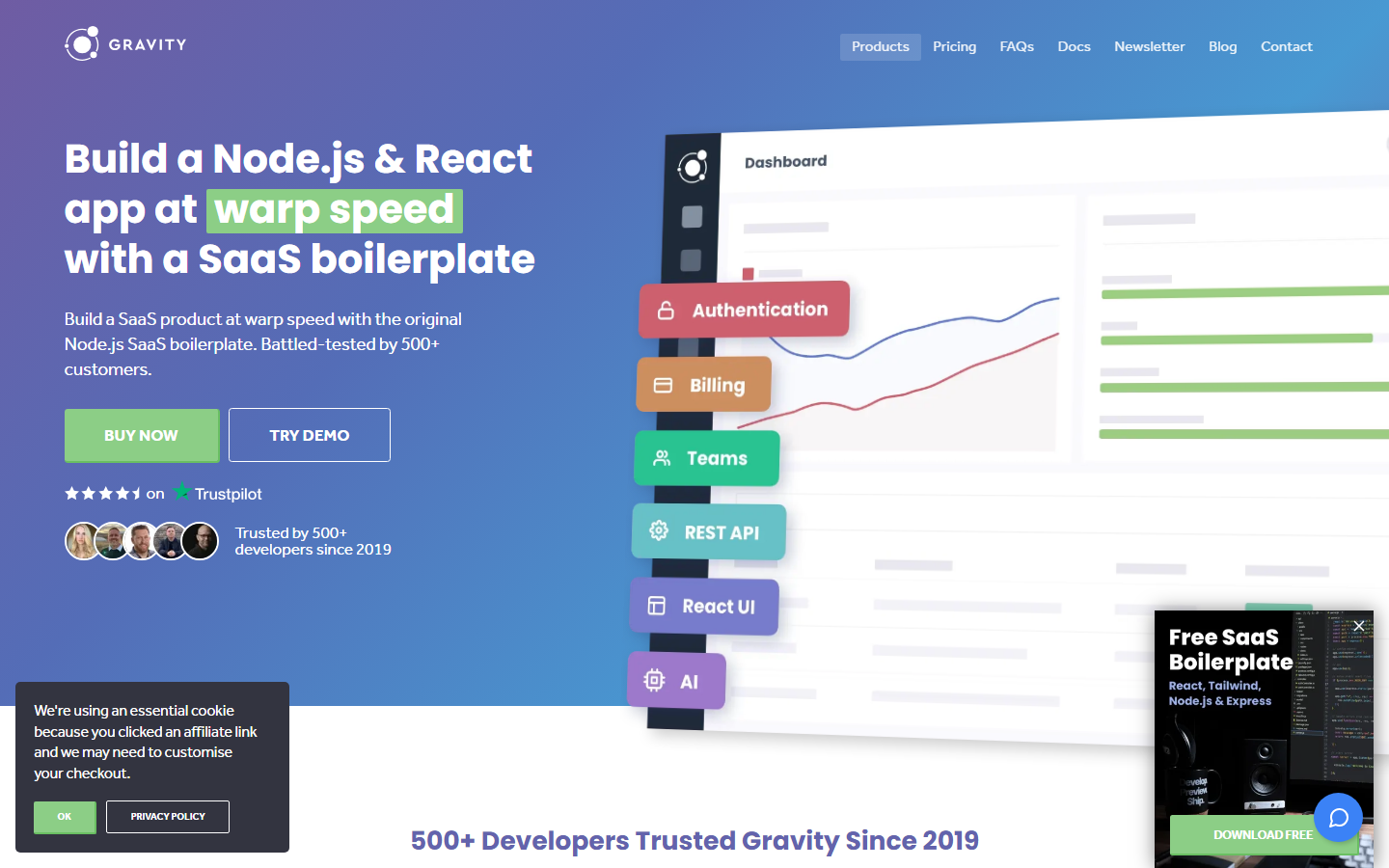
Gravity splits a Node.js API from a React frontend rather than shipping a Next.js monolith, which suits developers who want the backend to stand on its own. Pricing starts at $506 and reaches $2,995, the highest in this group and more than triple the $157 median, so it reads as a team or agency purchase rather than a solo one. The listed features cover only auth, payments and AI. Catalog staples such as email, SEO and an admin panel do not appear, so budget time for those.
Dirstarter
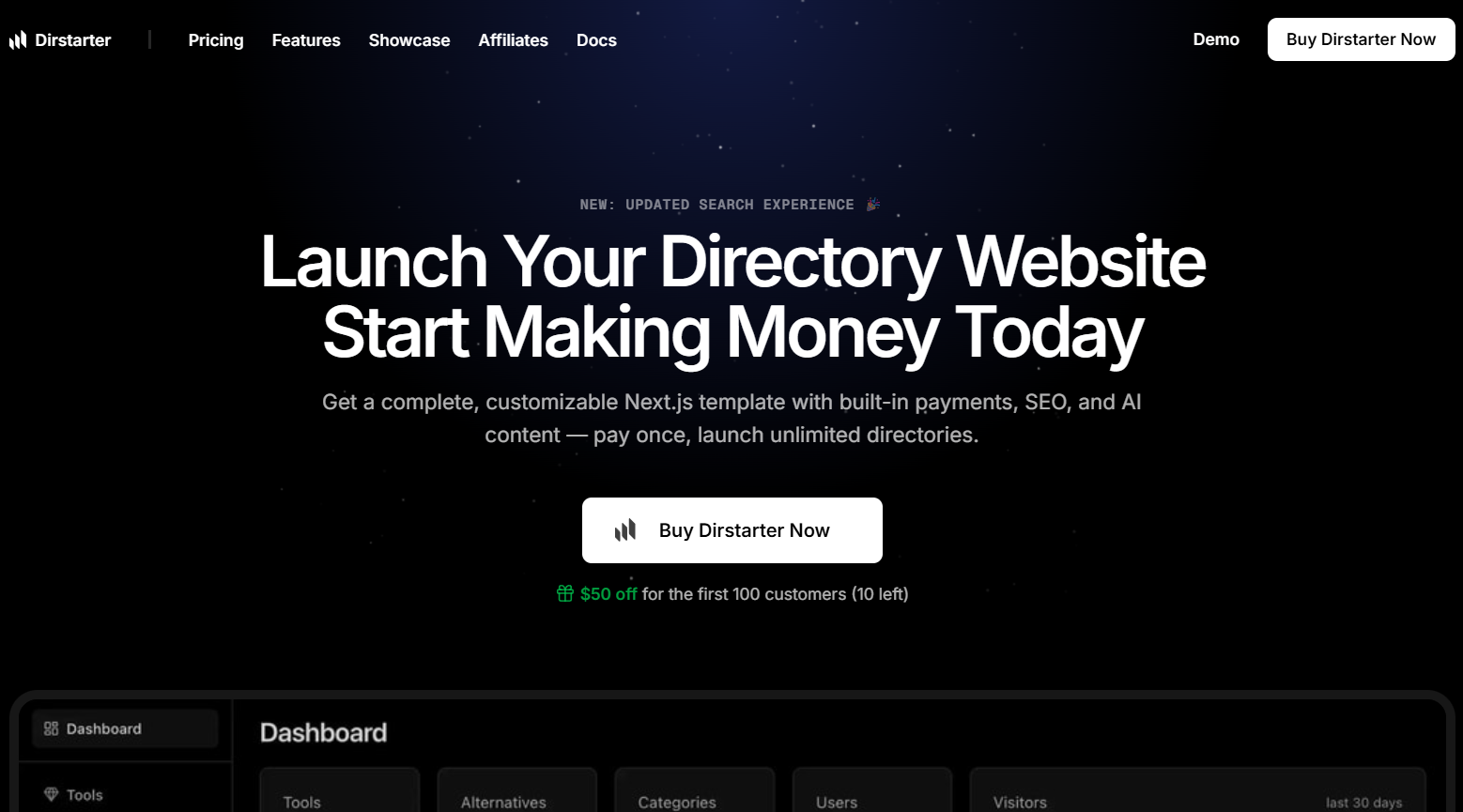
Another directory-focused NextJS build, using React, TypeScript, Tailwind, Prisma and Stripe, with AI-assisted content generation, analytics and SEO included under a pay-once license covering unlimited directories. At $159 to $199 it starts right at the $157 median and stays reasonable at the top tier. The unlimited-sites term matters if you plan several niche directories rather than one. Feature-wise it is leaner than some rivals: no auth, database or email appear in the listing, so account handling and transactional mail need attention early.
supastarter
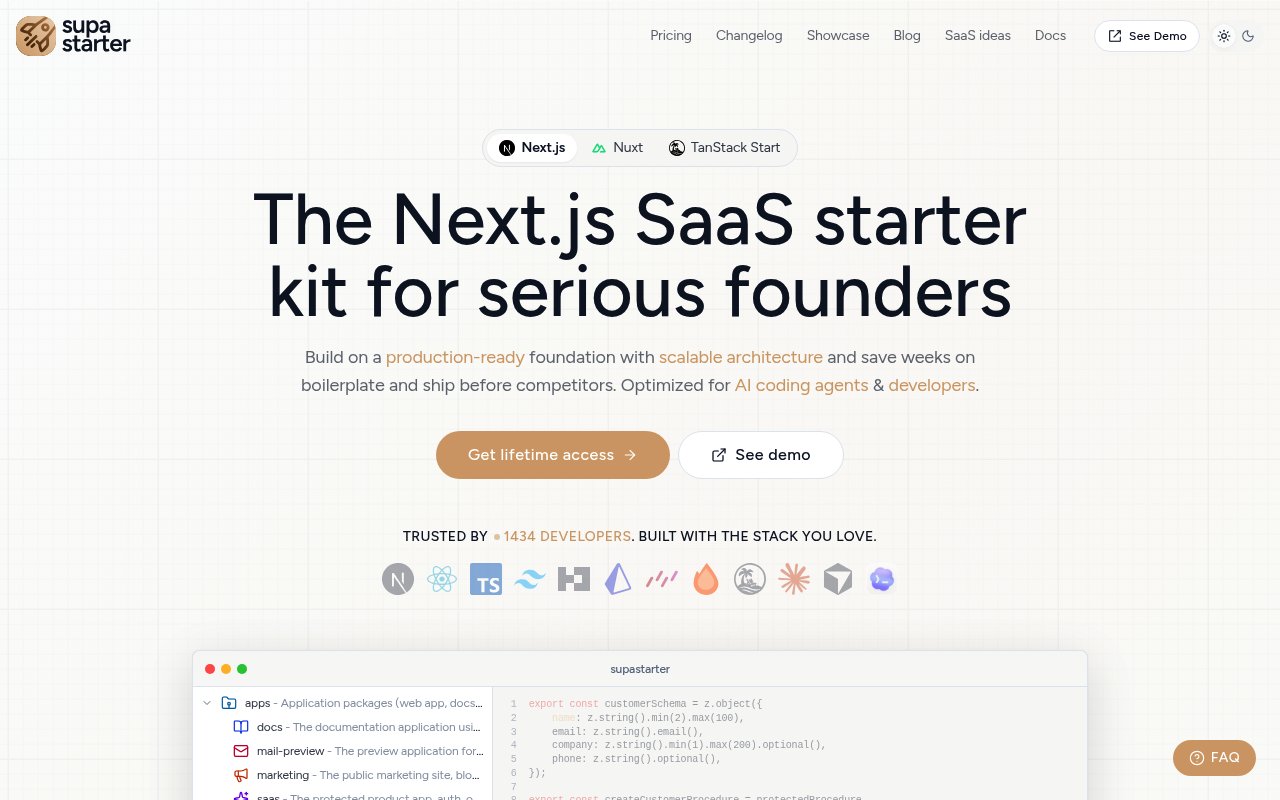
supastarter targets teams building multi-tenant B2B SaaS on Next.js or Nuxt, and it carries the deepest feature list in this group: multi-tenancy, i18n, admin panel, dashboard, user management, blog, documentation and AI on top of the usual auth and payments. At $349 to $1,499 it is the most expensive entry here, more than double the $157 median, so it only pays off if you genuinely need organization accounts, roles and translations. For a single-tenant side project, most of that surface area is weight you will never touch.
Frequently Asked Questions
What makes a boilerplate agent-ready?
Two things at minimum. First, an instruction file (AGENTS.md or CLAUDE.md) that tells the agent the project conventions, the commands it may run, and the boundaries it must respect. Second, at least one further signal: Cursor rules, packaged Claude skills, subagent definitions, or configured MCP servers. A boilerplate with only a README is not agent-ready, it is just documented.
What is the difference between AGENTS.md and CLAUDE.md?
They serve the same purpose and usually hold the same content. Claude Code reads CLAUDE.md, while most other agents (Cursor, Codex, Copilot and others) have converged on AGENTS.md. The common pattern in the boilerplates listed here is one canonical file with the other symlinked or referencing it, so the rules never drift apart.
How did you verify these attributes?
From public vendor documentation, changelogs and public repositories only. Almost every boilerplate here is paid and closed source, so the code cannot be inspected before purchase. A capability is marked present only where public evidence names it, absent only where a complete first-party file listing shows it is not there, and unknown otherwise. Each listing records the date it was checked.
Does agent-readiness matter more than features?
It matters more than it used to. If you plan to build most of the product with an AI agent, the quality of the instruction files and the consistency of the codebase determine how much rework you do, often more than the length of the feature list. A kit with fewer features and clear agent rules will usually get you further than a feature-rich one the agent keeps misreading.