
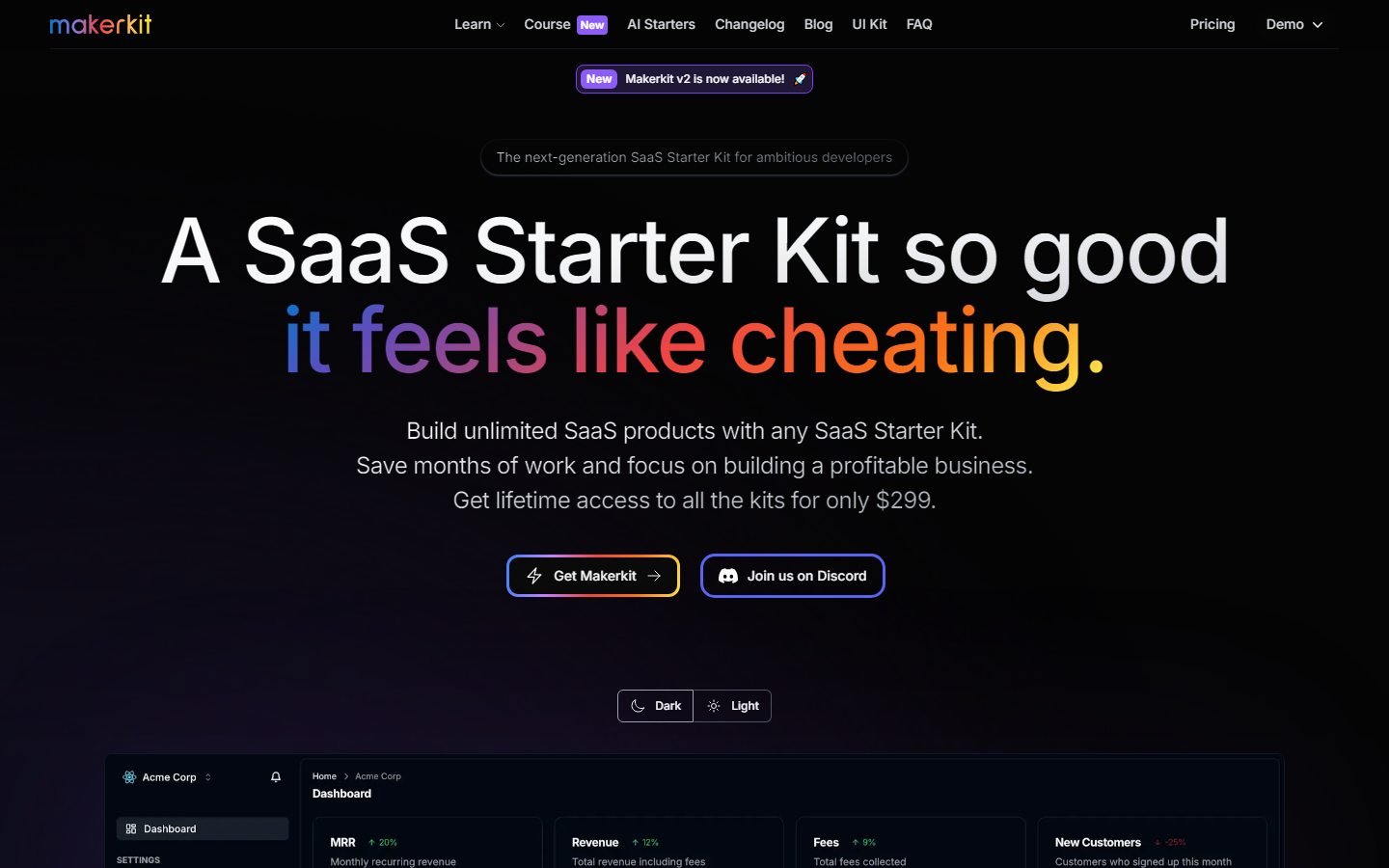
MakerKit Review: What You Get and What You Don't (2026)
This page summarises what we know about MakerKit: the stack it uses, the 7 integrations it ships with, how its price sits against the rest of the market, and who should buy it.
Verdict
MakerKit sits in the sensible middle at $299 to $599: more structure than ShipFast, less surface area and less cost than Supastarter. Its real selling points are documentation quality and the plugin system, which matter more than feature counts once you are six months into a codebase and need to extend it without forking. The catch is the Supabase dependency. Auth, database and storage all assume it, so your infrastructure decision is effectively made for you. It also offers Remix alongside NextJS, which is unusual. If you are happy on Supabase, this is the best-documented option here.
What Is MakerKit?
Launch your SaaS in days, not months. This NextJS boilerplate provides a fully-featured, production-ready foundation with authentication, multi-tenancy, Stripe payments, and a stunning UI. Save time and focus on building your business.
MakerKit Tech Stack
MakerKit uses NextJS, Better Auth, Supabase Auth and Polar. NextJS is one of the most common foundations in our catalog (31 kits use it), which means plenty of alternatives exist if MakerKit doesn't fit, but also that the ecosystem around this stack is well documented. The codebase is typed end to end, which matters more in a boilerplate than in your own code: you will be reading and modifying unfamiliar files, and types make that considerably safer.
What's Included in MakerKit
MakerKit lists 7 integrations: Admin Panel, Auth, Blog, Dark Mode and Documentation and 2 more. For context, the catalog average is 8 integrations per kit, so MakerKit is on the leaner side. Leaner is not automatically worse; fewer integrations also means fewer dependencies to maintain or rip out. Worth knowing before you buy: Components is commonly included in comparable kits but not listed for MakerKit. If you need it, budget the integration time yourself or look at the alternatives page.
MakerKit Pricing
MakerKit starts at $299 and goes up to $599. That is above the catalog median of $129, so it needs to justify the premium through its feature set or the quality of its implementation. One-time pricing for a codebase is hard to evaluate in the abstract; the relevant comparison is your own hourly cost for the setup work it replaces.
Who Should Use MakerKit
Fit depends on your project more than on the kit itself. MakerKit makes sense if you are starting a new project on NextJS and the included integrations match your requirements list. Since authentication and payments are both wired up, MakerKit covers the two integrations that consume the most setup time in a typical SaaS build. Skip it if Components is hard requirements for you; comparable kits include it already.
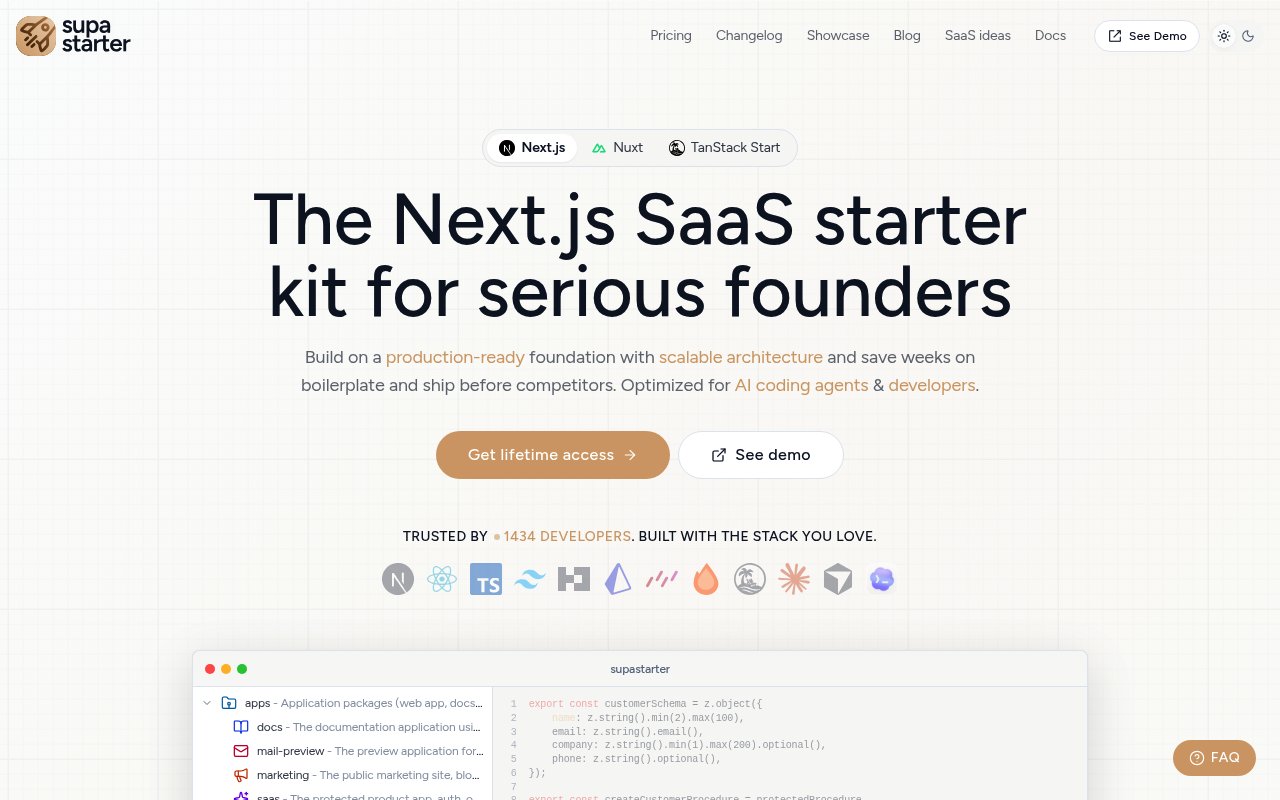
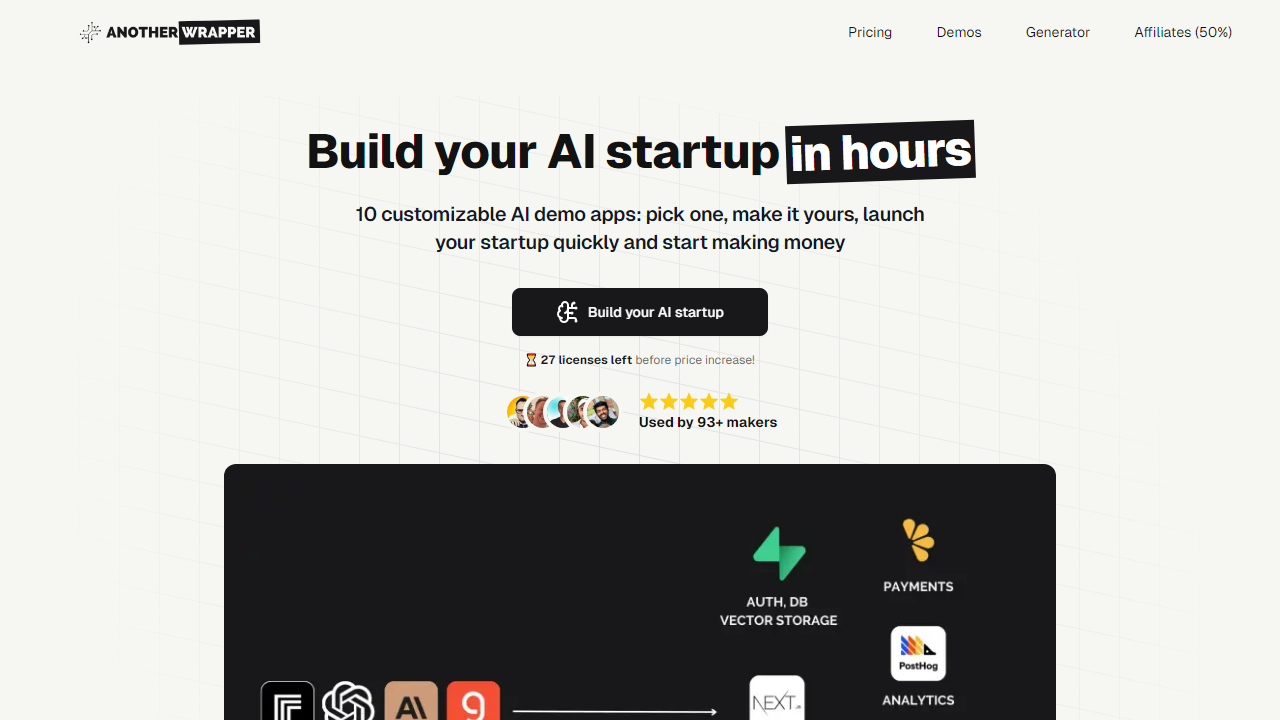
How MakerKit Compares
Pros
- ✓ Plugin system lets you add capability without forking the core, which pays off on long-lived codebases
- ✓ Documentation quality is its known strength, the thing that actually determines time to first deploy
- ✓ Covers NextJS, Remix and TypeScript, so you are not locked to a single React meta-framework
- ✓ Ships auth, payments, admin panel and multi-tenancy, the parts most teams underestimate
Cons
- ✗ Supabase-centric by design, so switching your database or auth provider means real rework
- ✗ Feature list is narrower than Supastarter: no i18n, analytics or email listed
- ✗ At $299 to $599 it costs roughly twice ShipFast for a moderate feature gain
- ✗ No listed AI tooling, so AI product builders start that layer from scratch
Best for
Developers already committed to Supabase who plan to maintain the codebase for years and want documentation and an extension path rather than the largest feature list.
Not for
Teams with an existing Postgres, Firebase or custom auth setup, and anyone who wants i18n or analytics included rather than added later.
Ready to try MakerKit?
$299 – $599
Frequently Asked Questions
Is MakerKit worth the price?
That depends on your hourly rate. MakerKit costs $299; building Admin Panel, Auth and Blog yourself typically takes days, not hours. If the included integrations match your requirements, the maths works out quickly. If they don't, the price is irrelevant because you would be buying the wrong kit.
What tech stack does MakerKit use?
NextJS, Better Auth, Supabase Auth, Polar, React, Remix, TypeScript, Supabase, Prisma, Drizzle, Resend, Stripe, Lemon Squeezy, Paddle. 31 kits in our catalog use NextJS, so if the rest of this kit doesn't fit, the stack itself won't limit your alternatives.
What's included in MakerKit?
7 listed integrations: Admin Panel, Auth, Blog, Dark Mode, Documentation, Payments, Plugins. The catalog average is 8 per kit. Not included: Components, which you would otherwise find in many comparable kits.
Who is MakerKit best suited for?
Developers who would rather inherit working integrations like Admin Panel, Auth and Blog than configure them. If you enjoy picking every dependency yourself, you are not the audience, and that is fine.
Are there good alternatives to MakerKit?
Yes. We maintain a ranked list of MakerKit alternatives based on shared stack and feature overlap. 30 other kits in the catalog use NextJS. See the alternatives page linked below.